When patients come to see me with heel or ankle pain, one of the first things they usually ask is: “Do I need surgery?”
The good news is that in most cases, the answer is no. Over the years, we’ve made huge progress in managing painful conditions such as plantar fasciitis, Achilles tendinopathy, and certain ankle problems without resorting to invasive procedures.
One of the most effective tools we now have in our toolkit is shockwave therapy.
With marathon and half-marathon season in full swing this autumn, I’m seeing an increasing number of runners and active people struggling with stubborn pain that just won’t shift.
But it’s not just athletes; many of my patients are people who are on their feet all day, or those who simply enjoy walking but find themselves sidelined by pain. That’s where shockwave therapy can make all the difference.
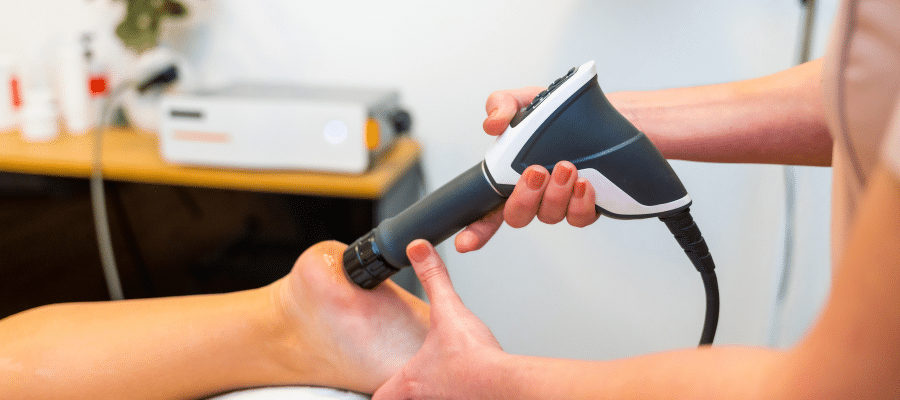
Despite its name, shockwave therapy has nothing to do with electricity. Instead, it involves delivering high-energy sound waves directly to the injured tissue. These waves stimulate the body’s natural healing response, increasing blood flow and encouraging the repair of damaged tissues.
The treatment is carried out in clinic, with no need for anaesthetic or hospital admission. It usually takes only 10–15 minutes per session, and patients can walk out straight afterwards. Most people require a course of three to five sessions, spaced a week apart, to see the best results.
Shockwave therapy has been particularly successful in treating stubborn, long-standing conditions that haven’t improved with rest, physiotherapy, or standard non-surgical treatments. The main ones I see in clinic are:
These conditions can be incredibly frustrating, particularly for runners preparing for a race or for people who simply want to stay active without pain. Shockwave therapy gives us a way of tackling the problem head-on without invasive surgery.
There are several reasons why I recommend shockwave therapy for the right patients:
A common concern patients raise is whether the treatment hurts. The sensation can be uncomfortable; like a series of sharp taps on the skin—but it is usually very tolerable. The intensity can be adjusted to ensure it’s manageable, and most patients describe it as “odd” rather than painful.
Importantly, because the treatment is stimulating your body’s healing response, the benefits often build gradually over the weeks following treatment rather than being instant. Patience really does pay off here.
Each year as autumn approaches, I see a wave of patients training for marathons and half-marathons. Many are nursing small injuries or overuse problems, particularly in the feet and ankles.
Training plans often involve steadily increasing mileage, which places repetitive stress on the Achilles tendon and plantar fascia. If these tissues aren’t given enough time to adapt, micro-injuries accumulate and pain develops.
For some runners, this pain lingers long after the race, or even forces them to stop training altogether.
Shockwave therapy is especially valuable in these cases. It can help athletes manage their pain, recover more effectively, and return to training sooner. Combined with a structured rehabilitation plan and load management advice, it offers a way back to running that doesn’t involve months off or surgery.
While shockwave therapy is not a magic bullet, it can be life-changing for the right patients. It tends to work best for those who:
It is not usually the first-line treatment; I often recommend physiotherapy, footwear changes, and activity modification first. But if those haven’t worked, shockwave therapy is an excellent next step.
How many sessions will I need?
Most patients require between four and six sessions, usually one per week.
Will I need time off work or sport?
No, most people continue with daily activities. You may need to reduce high-impact training temporarily, but complete rest is rarely required.
Is it safe?
Yes. Shockwave therapy is safe when performed by a trained specialist. Side effects are usually mild, such as short-lived redness, swelling, or bruising.
Does it work straight away?
Not always. Many patients notice gradual improvement over several treatments, as the body’s healing response builds.
Can it prevent me needing surgery?
In many cases, yes. For persistent heel or Achilles pain, shockwave therapy often provides enough relief to avoid surgery altogether.
Heel and ankle pain can be incredibly disruptive; whether you’re preparing for a marathon, trying to keep up with grandchildren, or simply walking the dog. Radial shockwave therapy offers a safe, non-invasive, and effective solution for stubborn plantar fasciitis, Achilles tendinopathy, and other ankle pathologies.
As a foot and ankle specialist, I’ve seen many patients who felt they had run out of options finally find relief with this treatment.
If you’ve been struggling with persistent heel or ankle pain, it might be time to consider whether shockwave therapy could help you. Please get in touch to book an appointment.
References
Dimitrios, K. et al. (2016). Radial extracorporeal shockwave therapy for the treatment of chronic plantar fasciopathy: a systematic review and meta-analysis. British Journal of Sports Medicine, 50(16), 972–981.
Gerdesmeyer, L. et al. (2008). Extracorporeal shock wave therapy for the treatment of chronic plantar fasciitis: a randomized controlled multicentre trial. Journal of Bone and Joint Surgery, 90(3), 270–278.
Rompe, J. D. et al. (2009). Shock wave therapy for chronic Achilles tendinopathy: a double-blind, randomized controlled trial. Clinical Orthopaedics and Related Research, 467(12), 3235–3242.
Speed, C. (2014). A systematic review of shockwave therapies in soft tissue conditions: focusing on the evidence. British Journal of Sports Medicine, 48(21), 1538–1542.
Mr Martin Klinke is one of London’s most trusted, and experienced foot specialists. He performs many bunion surgeries each year, and is a highly skilled surgeon.
He offers this surgical treatment to private self-funded and insured patients at the Cleveland Hospital and the Cleveland Clinic in London.
You can find all his patient reviews here.

